Helping Dealers Understand & Leverage Financing Products
Role: UX designer and researcher
Organisation: SNAP Home Finance
Timeline: 4 months
Skills: UX Research & Strategy • UI & Visual Design (Figma) • Prototyping & Interaction • Design Handoff & QA Testing • Cross-Functional
Tools: Figma • Miro • Confluence
The problem
How might we help dealers better understand their financing options?
SNAP Financial Group provides financing options to home improvement dealers, helping them offer customers more flexible ways to pay and improve their closing ratios. SNAP also supports dealers through promotions, customer service, marketing and training.
The Sales team identified that many dealers, including long-standing partners, weren't using SNAP's financing products. While dealers had access to SNAP Central, which allowed them to review payment options and submit financing applications directly with customers, some weren't using the app or weren't confident navigating the financing process.
Research also showed that the issue extended beyond the app. Dealers were often relying on Sales and Customer Service for information that wasn't consistently available elsewhere.
This highlighted an opportunity to make financing information and support easier for dealers to understand and access independently.

Opportunities
For users:
An improved experience would help dealers better navigate the app, understand the value of offering financing and feel more confident using it with their customers.
For the business:
Improving dealer engagement could lead to an increase in financing applications, higher retention and revenue, as well as reducing customer service calls and time spent onboarding.
Constraints
Limited existing user data and understanding of our users and their end-to-end journeys
Designs needed to work across English and French
Different provincial requirements needed to be considered
The solution needed to work within the existing SNAP Central product and design system
Discovery
To better understand our dealers and their pain points, I conducted interviews with the Sales and Customer Service teams.
One of the first things I discovered was that there was no consistent onboarding or training process. Different teams used different tools and presentations, meaning the dealer experience could vary depending on who they interacted with and when they needed support.
We also identified several key barriers: fear of new technology and processes, uncertainty around how to offer financing, lack of time and limited understanding of the products.
Insights
Research revealed two key issues: inconsistent communication at key touchpoints and reliance on internal teams for basic questions.
We saw an opportunity to improve lifecycle communications through clearer personas and journey mapping, while centralising self-serve resources in the dealer app to help dealers find answers independently.

Personas & User Journey Mapping
Using the interview findings, I led brainstorming and whiteboarding sessions with Product and Marketing to challenge our assumptions and develop three main dealer personas.
Designing for Mental Models: Personas ranged from tech-savvy power users to "Reluctant Roys"—dealers who expressed high anxiety around digital tools and preferred phone support.
Jargon Overload & Task Orientation: Rather than designing separate onboarding flows for each profile, we focused on their common friction point: jargon fatigue and discovery frustration.
Task-First vs. Internal Hierarchy: Dealers don't navigate by internal product module names; they look for quick answers to specific daily tasks. Deep navigation menus increased cognitive load, signaling a clear need for a search-first approach.
These insights informed automated Salesforce journeys and targeted email communications across key touchpoints, including onboarding, promotions, and re-engagement.

Planning Stage
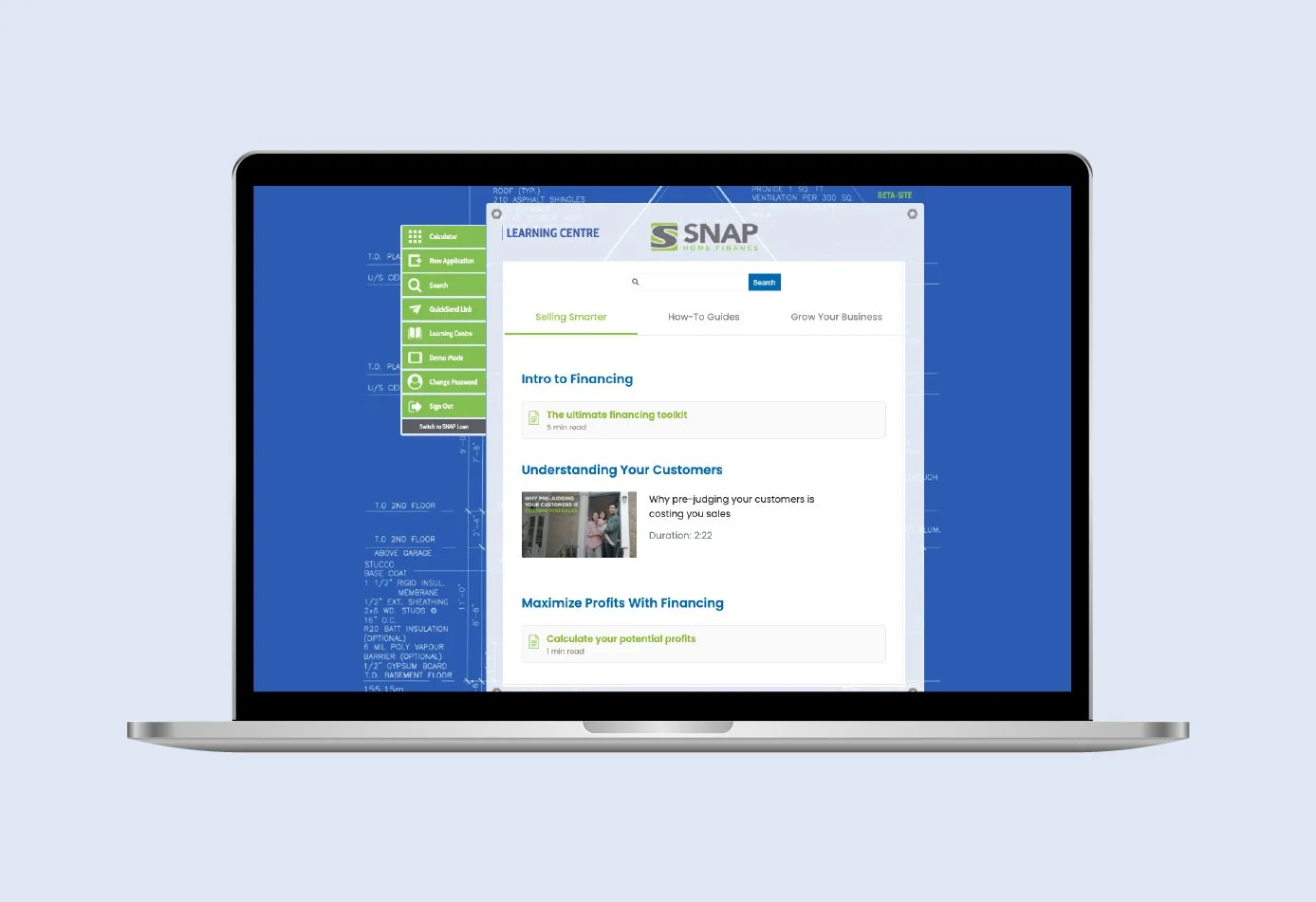
Through the persona development and journey mapping, we identified where dealers were relying on Sales, Customer Service or other processes to find the information they needed. This highlighted an opportunity to bring more self-serve support into SNAP Central through a centralised Learning Centre.
We used the persona needs and dealer journey to define what information and resources dealers would need, and how these could fit into the existing product experience.
Structuring the Learning Centre
I translated these insights into the Learning Centre's information architecture, organising the content into three sections based on the needs we identified.
For example, "Reluctant Roy" wasn't yet convinced of the benefits of financing and found the products confusing. We used these barriers to determine what information he needed and how it should be presented.
Alongside the design process, I created a work plan to coordinate the product, content and operational requirements needed for launch, allowing the different teams to work in parallel.

Designing the Learning Centre
Once we had established the structure of the Learning Centre, I translated the persona needs into low-fidelity wireframes and interactive prototypes, working within SNAP Central's existing design system across different screen sizes.
I worked closely with the Tech team throughout the design process to understand technical constraints early and make sure the experience was feasible within the existing product.
When we presented the early prototypes to Sales, we identified that dealers needed to find information using the language they used day-to-day. The challenge was making resources easy to find without adding another layer of navigation.
Rather than relying on how we had categorised the content internally, I explored how dealers would actually search for information. This led to a top-level search experience using tagged metadata and keyphrase indexing. I designed the search UI, information architecture and tagging system around dealer mental models, including auto-suggestions and scannable results.
Tech Handover & Testing
As the designs progressed, I worked closely with engineering and content strategy to resolve technical constraints and bridge the gap between design vision and implementation:
Custom Metadata Taxonomy: Built a search tagging system mapping dealer terminology (in both English and French-Canadian) directly to technical product names, overcoming legacy search engine limitations.
Bilingual UAT: Conducted usability testing across English and French-Canadian cohorts to ensure regional terminology felt natural, resolving translation mismatches prior to launch.
Agile QA Loops: Maintained continuous feedback cycles during development sprints to ensure responsive layouts and accessibility standards met design system criteria without delaying timelines.
We then ran UAT with a beta group of dealers to test the experience in a real-world context. I gathered feedback and worked with the team to make further UX/UI iterations before release.
Product Release & Adoption Strategy
I worked with Sales and Customer Success to introduce the Learning Centre consistently as part of the existing dealer experience:
Salesforce Triggers: Integrated automated triggers notifying account managers when dealers onboarded, enabling timely, targeted outreach.
Phased Campaign: Rolled out a structured email sequence guiding dealers through high-value tasks within the new Learning Centre, encouraging lapsed dealers to return when they needed support.

Success Metrics
App usage: Increased active app usage by 22% within three months, including re-engagement of lapsed dealer accounts.
Customer support: Reduced FAQ support queries by 15% by giving dealers a self-serve place to find answers and resources.
Key Learnings
Looking beyond the interface: This project reinforced that UX doesn't exist in isolation. Mapping the broader dealer journey—including offline sales touches and customer service calls—helped us fix the root causes of low engagement rather than just building UI screens.
Designing around how people actually work: I learned the value of stepping back from internal product taxonomies to focus on how users naturally think and search. Pivoting from deep navigation categories to a search-first approach directly reduced friction for dealers in the field.
Early cross-functional alignment: Involving engineering, content strategy, and sales early in discovery—rather than waiting for handoff—helped us catch technical constraints, avoid major rework, and build a solution that was feasible from day one.
Navigating real-world constraints: Balancing bilingual requirements (English/French-Canadian), provincial differences, and existing design system limits required pragmatic trade-offs that protected the user experience without compromising timelines.
Designing for long-term adoption: A launch is only successful if users keep coming back. Tying the Learning Centre directly into Salesforce automation and sales enablement made the feature a core part of onboarding and ongoing support rather than a one-time release.